THE STORY OF ROBIN HOOD AND HIS MERRIE MEN (1952)

(Hat not appearing in this film)

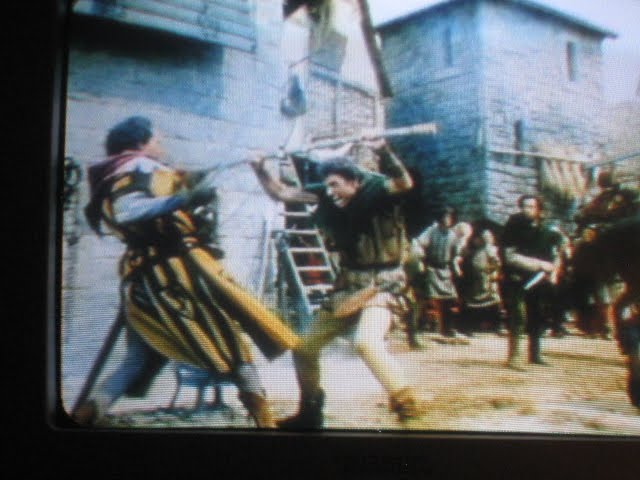
PLOT - After a mid-70s vintage Wonderful World of Disney intro, showcasing a few better movies, a lot of worse ones, and many many shots of people having aggressively manufactured fun at Disneyland, we start our movie proper. Whoa. An RKO Radio Picture. Retro. Well, here we are in the good old days, when a fundamentalist Christian head of state could invade the Middle East without everyone getting all sensitive about it. The Earl of Huntington is of to Crusade with the king, and his daughter Marian is staying with the queen. His estate is being looked after by his servant Hugh Fitz-Ooth, and Hugh’s son Robin, because poor people can‘t join the army. Or something. Once the king is safely out of the way, the Prince commences to plottin’ and tells his lackey the Sheriff to hold an archery contest, and ask all the kick-assest archers to join his army. Hugh wins impressively and denounces the sheriff even more impressively. On the way home, this happens.


Robin : Gee dad, do you think you should have upset that powerful asshole who works directly for the king’s brother, who is in charge right now?
Hugh : I wouldn’t worry about it son. See, the sheriff HURK
(Hugh falls over with an arrow in his back)

I’m paraphrasing, but only slightly. Anyway, Robin lives in the forest and collects a group of like-minded fellows, as per usual. At one point, they capture the Sheriff and ‘invite’ him to dinner at their camp, liberating him of much of his treasure as part of the ‘bill’. It’s so cute. Two years later - TWO?! - the king is kidnapped, and Marian gets word to the outlaws, who boldly pay the ransom using money stolen from the Prince. There’s some more plotting, Marian gets kidnapped, fight fight fight, and the King shows up at the end to tell Marian that she must leave the woods and marry the Earl of Loxley. And guess who just got that title? Oh, that King Richard I. What a jokester.


(It begins, as do all good Robin Hood movies, with a monorail)

GENERAL THOUGHTS - I’m returning to my old style rather than separating the good, bad, and other, because in this movie, the good, bad, and other are all the same thing. See, this movie is extremely 1950s. Now, I know that’s not the kind of thing one expects to see referenced as a positive, but hear me out. The 50s were a time when you could have a guy living in the woods as a hunted man and still play it as fun, rather than anything serious. And fun it is, with Robin placing lots of emphasis on camaraderie and feasting and such. I’ve mentioned before having issues with why Robin gets so many people following him, but in the candy-colored world of this movie, he’s exactly the sort of guy you would follow. I’m not sorry we’ve lost this attitude, gosh knows entertainment is generally better these days, but it’s kind of fun to see a Robin Hood that’s free to just enjoy himself.


(Robin and Marian play hide and seek. On an unrelated note, who here's seen The 10th Kingdom?)

Now as far as the actual filmmaking goes, I really like that they use aspects of the story that everyone knows, yet twist them around a bit so they're still unexpected. For example, rather than having the sheriff’s man hit the bull’s eye and Robin split his arrow, they have the sheriff’s man juuust barely miss the center, Robin hit it, and then Robin’s dad split his son’s arrow. (Which also solves the problem of how that makes Robin the winner, rather than resulting in a tie.) Or rather than have Robin make a really obvious “Here, let me blow my horn for no reason, Mr. Angry Tall Guy” move after losing to John on the bridge, he complains that his horn may be waterlogged, and blows into it to “clear it out”, thus sending his men rushing to his aid. There’s also a lot of fun innovative bits added. I particularly liked the use of color-coded arrows with whistles on the tips used by the Merries to send messages to each other. Oh, and that they angle their bows up when they fire, rather than just acting like an arrow’s just going to go straight like a bullet.


(A member of the upper church hierarchy who's not evil? Fuckin' 50s.)

But for all that great stuff I mentioned, there’s a dark side. See, I mentioned that they take well-known bits and twist them, but they assume possibly way too much familiarity on the audience’s behalf with the story. There’s no mention of why he’s called Robin Hood rather than Robin Fitz-Ooth, there’s no mention of where Scarlet and the rest of the Merries come from, and every major plot action is so vague, I could only make sense of some of it by associating it to other Robin Hood stories I had read. I suppose in the 1950s, they were expecting young people to be more familiar with Robin Hood, but it still strikes me as bad storytelling. Also, while the performances are natural and charming, the production value is anything but. Costumes and sets range from cheap but acceptable to just plain painful. And lacking, one must assume, as skilled an archer as the one who was firing arrows into the armored stomachs of extras in 1939, most arrow shots consist of Robin firing his bow followed by a whip pan to the victim holding an arrow to his chest and grimacing. It’s really stupid. And there’s that two-year jump in the story after the sheriff leaves their camp. Even for this movie, that’s a bit mind boggling.


(See, this was made when people were supposed to like Crusaders.)

Look, what it comes down to is this. This is a huge slice of 1950s cheese. The opinions you have of it will be affected by whether the good outweighs the bad for you. The performances are winning, the dialogue is lacking, the plotting is horrible… There’s not much consistency here. Me, I found it to be a whole crazy bunch of fun. It was nice to watch a completely unserious version of the story. And I know this sounds weird, given that I’ve now spent a huge chunk of this review on relatively earnest analysis instead of jokes, but it was nice to give my brain a rest and enjoy the fun. This move made me feel more like the kid that read his Grandpa’s Robin Hood book over and over on the porch than any other I’ve seen so far, and that can’t be a bad thing. So, yeah, the 50s. Good, bad, and everything in between. Damn, this section was like an entry unto itself. Okay, back to the funny.


(Hast thou thy tickets... to the GUN SHOW? Quickly, fetch me some snake oil... FOR THESE PYTHONS ARE SICK.)

ROBIN - Well, as has already been mentioned, this is a more fun-loving Robin Hood. I also like that his plans frequently involve publicly shaming the sheriff, rather than merely stealing from him. Robin doesn’t just help the poor, he empowers them by making their oppressor look like a fool. Again, this wouldn’t fly today. The BBC sheriff is occasionally made to look silly, but if the townsfolk laughed at him, he’d feed their children to his birds. But here in Disneyland, Robin is free to be whimsical. Richard Todd is a decent enough actor, more than enough for what this movie requires, and his romantic interests are believable. But he doesn’t wear a Robin Hood hat! I swear to crap, if this movie’s gonna go all über-50s on us, the least they could do is throw in an adventurer’s cap for the bossman.


("What is this? Do I eat it?")

LITTLE JOHN - This Nicol Williamson lookin’ mofo is pretty good, as standard Little Johns go. The bridge scene carried shades of The Outlawsof Sherwood in that they were clearly testing each other, except here they’re having fun and not being crabby. After he wins and joins the band, they “baptize” him by throwing him in the river, and he proceeds to happily fulfill the big jolly guy role. He's smart, too, which is nice. Other than that, there’s really nothing of note, save his fun fur hat, styling beard, and pre-fight warm-up. You know how when a movie wants to make a swordsman look impressive, they’ll have him flourish his sword all around before the fight? Well, this guy does that with a six-foot quarterstaff. And I don’t mean he does some cool staff moves to show off, I mean he holds it like a sword and swings it around. It’s so cool.


(Let's see, good Will joke... Journal of the Wills? Too obscure. Triumph of the Wills? Too Nazi. Bondage of the Wills? Noooo...)

WILL SCARLET - WOO! Threefer! Not only do we get a blandly portrayed Will whose costume promises a vastly more intriguing character than is delivered, we get two more Wills in the bargain! Scathelocke and Stutley both make last-name-only appearances, probably because some Disney staff writer didn’t realize they were all the same guy, and thought that 13th-century balladeers were just lazy at coming up with first names. Scarlet is Robin’s cousin, which I honestly did not hear mentioned until the fifth time I watched it. As for the ex-Wills, they’re used to represent two kinds of oppressed peasant, with Stutely caught poaching and Scathelocke (played by Sir Michael Hornden. Well, by regular Michael Hornden at the time.) arrested for non-payment of taxes. The scene that follows is… weird. Scathelocke goes into a pillory. Okay, sure. Stutely is… um… Well, he’s dressed like a deer and suspended in midair over a smoking brazier. Then… then the guards all ride around in a big circle, and hit him with sticks whenever they pass. What the hell? There’s a fun editing mistake where one of them tries to hit Scathelocke‘s back, and whacks him right in the teeth. He's fine afterwards, which I guess means those sticks don’t hurt as much as you‘d think. Sadly, the Gollum-like Stutely uses the beating as an excuse to not wear a shirt for the next few scenes. Eww.


(I simply must goooooo...)

TUCK - Why, I remember at the Ren Fair the scene where Friar Tuck has a little conversation with himself, playing the role of friendly-inkeeper type and polite stranger, convincing himself to eat and drink. That was good stuff. The same scene is played out here, only when Tuck’s turning down the drink, he does a flirty girl voice, and when offering it, he does a seductive man voice. It’s like some weird medieval version of “Baby, It’s Cold Outside”. He’s an acceptable enough Tuck, the usual sort of kind reassurance and a bit of wink-wink-nudge-nudge to Robin and Marian. What throws me is his look. His robe is an off-putting light grayish tan, and he’s clearly got a few pillows stuffed down the front for that Tuckian physique. Also, he’s got that weird sort of neck beard I let myself grow over the summer. Wow, this entry has given up on any pretense of being read by people who don’t know me personally. (Speaking of which, please note that at 4:47 in the scene I linked to, Robin calls Tuck a “lusty infant”. I am proud to say that was a reference to my writing, and I didn’t even know about it until I saw the scene. It‘s a great feeling for a writer to be referenced. Gives us a tingle.)


(Robin Hood versus the hideous troll-beast.)

MUCH - Speaking of name variants, we finally get one here. Midge the Miller is actually sort of a fun character. He’s not one of the Merries or even a likely applicant when he first appears. He’s just some absolutely hideous middle-aged miller with a body like Don Knotts and a face like the south end of a baboon heading north. He’s a sneaky miser who tries to transport his gold through the forest in a sack of flour, and when the fellas catch wise, he throws the flour in their face and kicks some pretty serious ass. Sure, he loses in the end, but it was like four on one, and he did good. Later on, he’s bumming around the camp and sees the light, voluntarily donating his coinage to the cause. (When the fellas catch wise? What am I, Edward G Robinson?)


(You may leave now, Lady Buzzkill.)

MARIAN - Absolutely fantastic Marian here. Too often it seems that the only two options for portraying Marian are to make her a stereotyped damsel in distress or a butt-kicking action girl. Or worse yet, they act like she’s a butt-kicking action girl, but just have her get captured all the time anyway. (coughPrinceofThievescough) In this movie, Marian engages in ladies’ pursuits, wears pretty dresses, and gets captured, but she still manages to be remarkably proactive. She sneaks away to meet the outlaws, and is the one who presents their money to queen Eleanor toward the end, thus clearing their name and increasing their public image. Moreover, her relationship with Robin is wonderfully playful. Her introductory scene has her intentionally messing up his archery practice by jostling the target, then making him describe his ideal woman, clearly meaning her. He describes someone tall, blonde, and blue-eyed, and when he mentions sweet-tempered, she kicks him in the shin. It’s hard to describe without sounding cutesy, but basically this is one of the versions where I see Robin and Marian getting together because they like each other, not because plot demands it. Plus, she looks just adorable in her Merrie Men outfit.


(See? Told you.)

SIR GUY - No Guy here. Actually, the John/Sheriff relationship here is a lot like the Sheriff/Guy relationship in later adaptations. John seems overly concerned with this relatively small area of England, and the plot would be a bit smoother if he was a local lord instead of the Prince Regent. Ooh, look I actually complained about something. Let’s go into some more detail, shall we?


(I need not tell thee things are bad. Everybody knowest things are bad. 'Tis a depression. I be enraged as the very flames of perdition, and I shall take it no longer!)

SHERIFF - When the Sheriff was introduced, I found myself quite surprised. He was a dignified looking older gentleman, who seemed to genuinely be a force for law and order. Why, he’s even offering to go along with the king to the… Crusade… Ohhhh, now I get it. John is given the job of finding the replacement, and chooses him offscreen. I’m not sure how he was selected, but I’d guess Evil Beard Contest. Anyway, he has little to do here but order the guards around and bluster impotently. And the guards are interchangeably described as soldiers and foresters. Same thing, right? He is played by Peter Finch, who is one of two actors ever who are so awesome, they won an Oscar after they died.


(Hair by Conan O'Brien)

THE MAN - Well, as I said, John is far too concerned with Nottingham, and the Sheriff is pretty much just the head of the guards, but putting that aside, how is he? Not too bad. In his introductory scene, he’s seeing off the King, and he’s all like “Oh, DARN, I really wish I could go with you seriously totally. Okay! Well, bye, don’t hurry back, I’ll keep your throne warm.” He then immediately commences to scheming on how to bilk poor peasants in one region. As for the king, he leaves at the beginning and shows up at the end, as per usual. I’m beginning to really hate it when the king shows up at the end. It’s one thing if he shows up near the end and helps out, but when he just turns up to throw out some titles and end the movie, it seems cheap.


("John, what are you doing back there?" "Um... scheming.")

Queen Eleanor also takes a major role in this, which I like. I haven’t reviewed much with Eleanor in it, but whenever she shows up she tends to be portrayed as Her Royal Sassiness. This is probably in line with history, seeing as Eleanor, not John, was actually Richard’s regent during the Crusade. That must have been an awkward family meeting. “John, your big brother Richard is going on a crusade.” “Yes! I get to be Prince Regent!” “About that. I know you’re next in line for the throne, but I’ve been missing the queening, so I figured I’d just step in and take over.” “No fair! You already got to rule the country!” “My decision is made, John! You‘ll just have to wait until Richard dies, and in the meantime, you can make some ineffective attempts to overthrow my underlings.” “Fine! I’ll do that! And then I’ll be king, and when I am, I’ll fight with cousin Arthur, and lose Normandy, and get excommunicated, and have terrible relations with the barons until they all but force me to sign the Magna Carta, thereby laying the groundwork for constitutional law in Europe!” “That’s nice dear. Maybe in 400 years, they’ll retcon you into an existing legend as a villain.”


(I swear, if one more of you assholes yells "Freebird"...)

OTHER MERRY MEN - Alan A’Dale shows up, and I actually quite like him. He narrates the film, but of course, so we have to put up with his balladeering ways every so often. The neat hook is that he’s not narrating from the future and singing a prepared song, but rather going around during the story making up ballads about Robin’s latest exploits while begging for coins. So it’s a combination of retelling stuff we’ve seen and revealing stuff we haven’t, while and at the same time showing Robin’s growth as a folk hero and having Alan seem like an actual minstrel and not just an outlaw with a mandolin. It’s kind of like the news reports in Starship Troopers, showing us the progress of the war and how it’s perceived. Just with less Nazi Howser and more hey-nonny-nonnys. Alan has a dog, too, which I don’t really get, but whatever.


(This random guy takes down the Sheriff like three times in group fights. Must be the director's cousin or something.)

OTHER VILLAINS - None spring to mind. According to online sources, one of the sheriff’s thugs got a name. Red Gill. I didn’t say it was a good name. Red is played by Archie Duncan, shortly to achieve fame as TV’s Little John. Good for him. I guess I can throw in the Archbishop. He doesn’t do anything evil, but since the upper echelons of priesthood tend toward the evil in these things, I’ll count him here. Just so Red won’t be lonely.


The original Sheriff and his EYEBROWS.)

BEST LINE - Will : Are you of a mind to join us? You’ll eat fresh meat every day, sleep soft, and have money in your poke!
Robin : Ah - Provided you kill your own food, make your own bed, steal your own wages, and give them to the poor.

WORST LINE - There‘s a lot of silly ‘50s lines in this, which sometimes provoke eye rolls, and sometimes giggles and hand clapping, but the line that most stood out on my viewings was “We’ll split Prince John from nottle to nock!” Look Alan, I know you’re a minstrel, and people expect your suggestions to be a bit whimsical, but that just sounds silly. But as it is my custom to fix these ridiculous lines, allow me to suggest a different one…


COMING UP NEXT - Soooo… Dom DeLuise’s son directed a SyFy channel movie where Robin Hood fights a dragon. It’s full of Canadian actors and shitty CGI and also there’s some fairies in it. Ah, sometimes, the world sends me beautiful gifts.


(Take that thing off, Jerry, you look like a dumbass.)


PLOT - In the year 108X… Well, the Normans have just now invaded Wales, and a young Welsh prince is not having such a good time. His dad was slaughtered, his lands taken, and when he goes to Lhundien (London) to see wot’s all this then, he is told he has to pay a stupid huge “administration fee” to get the land back. Now, with the help of his dad’s greatest warrior, a Norman priest, and a load of even scummier than usual peasants, he must return to his home to get the money to buy his land back. CAN YOU FEEL THE THRILLZ? When he does, he is informed that there’s a late fee, because England is run by librarians. Which is good, because the thrilling tale of a headstrong young prince filling out form 32-B for Return of Homelands (Ancestral) is not exactly gripping drama. When he returns home again, the guy currently squatting in his digs decides he quite enjoys the boiled sheep and constant harp music and elects to keep the place by killing the rightful ruler. So he hides in the woods, makes a bow, and decides to earn the money to buy beck his lands the cool person way: Steal it from the assholes who took the land in the first place. He rejoins with his friends, makes some clever plans, gets a giant bird costume, the usual Robin Hood stuff. Oh, yeah, you heard me. He wears a giant bird costume. And not for just one mission or something. All. The. Time.


(Inasmuch as this is a book and leaves me no photos, most images in this review shall be of famous Welsh persons and aspects of Welsh culture, such as it is.)

THE GOOD : Setting the book at this time and place brings the Norman/Briton conflict to a real head that’s often lost in the adaptations that take place 200 years down the line. The author does have a way with words, and during many of the descriptive bits, you really feel transported to the time and place. His dialogue sounds suitably antique, but not so much so that it’s stiff or dull. And the book is just full of historical tidbits about politics or everyday life that don’t slow down the plot. And the idea of him buying back his land may sound lame, but it’s a nice twist on some of the old stories where he was stealing to ransom King Richard from the Bavarians. All these aspects combine to make this book an extremely satisfying read is what I would be telling you if the author could pull his head out of his ass.


(Little known fact: The Welsh love to eat gold.)

THE BAD : As you may have guessed, astute literary tone detector that you are, the author’s head spends a lot of time wedged up his ass. He just can’t help finding himself fascinating, and as a result, the book has a tendency to sprawl all over the place and grind to a halt every couple chapters as we learn another fascinating historical tidbit that is not worked naturally into the story at all. It’s enough that we know Bran made a bow, we don’t need to know how he seasoned the wood. It’s enough that we know De Braose built a castle, we don’t need to know how he sealed the cracks between stones. And his tendency to try and make his noble’s dialogue as show-offy as possible led to not only the worst sentence in the book, but the worst sentence I’ve ever read in any novel ever. This will be discussed at length later.


(This book is about a prince of Wales, not the Prince of Wales. Thankfully.)

THE OTHERWISE WORTHY OF MENTION : I tried reading this one in the old-school ink and paper and glue and cardboard edition, but it was tough going, so I went for an audiobook instead. This job gets easier when I can do it while driving, but it's difficult to the point of impossible to go back and check things, so I wound up pretty much reading the book anyway when I skimmed it to make notes. I've found the author, Stephen Lawhead, referred to in multiple places online as a "Christian novelist", but there was none of that on display here, despite all the priests. Which is good. Seeing Robin Hood thank Jesus every time he successfully steals something would be weird, to say the least. Though not as weird as that movie where Santa Claus prays before his flight.


(Adam Verner indicates his nipple.)

AUDIO BOOK NARRATOR ADAM VERNER : He’s okay. He certainly has a good grasp on the actual narrative parts of the narrative, and his descriptions are interesting to listen to. He manages to hold the listener’s attention pretty well, even during the long, boring parts. He’s American, and doesn’t try for accents, but his character division is still good. The only thing is… I do own a copy of the actual ink and paper and cardboard and glue edition of the book, and therefore I know there is a Welsh pronunciation guide at the end. Maybe the guy could have looked at it? He makes a good guess at everything, and it’s not so noticeable that I’d still know if I hadn’t read it. But still, it’s a little annoying when he gets nearly every one of the countless Welsh words wrong. And he pronounces Brychan differently for Rhi (King) Brychan and Bran ap (son of) Brychan.


(Run in terror, Norman swine!)

ROBIN : Real name- Bran ap Brychan. For all of you who were wondering why that would bother me, there’s your answer. Code name - not Robin Hood. It’s “King Raven”. He’s also considered to be a sorcerer. King Raven the Sorcerer in Welsh is Rhi Bran Hwd. So, you know. There’s that. As a character, he’s very much in the classic idiom of “Wealthy layabout grows a pair and fights a corrupt power” Hood. This can be a tough kind of Hood to do well, and the book mostly does a good job of it. They surely ramp it up one of twenty notches. Rather than a noble losing some land based on a technicality, he’s a prince losing his kingdom to conquerors. Rather than running off to the woods with his jolly bunch of lads, he’s chased down like a dog and saved from the brink of death. As far as his outlaw exploits go, I just really hope they never make a movie on this one, because no matter how dark and gritty it is, he still dresses like a giant bird.


(I don't care what he says, it is unusual.)

LITTLE JOHN : Poor Iwan. Even when he’s all Welshed up, he gets less character development than everyone else. He’s the leader of King Brychan’s war band, and the only survivor of the battle that takes their lives. He’s built up as being a loyal subject and faithful friend and caring advisor and father figure to Bran, but rather than actually doing stuff that involves that, he mostly stands around and scowls. He’s good at it, but still. His nickname comes when Friar Aethelfrith says that his name is John in “civilized language”. The Little part is for the usual reason. Actually, it’s the only time the book took the easy way out instead of trying to be clever. Nobody cares about Little John.


(I made this with technology!)

WILL SCARLET : He rather irritatingly fails to make an appearance for the entire book. Why is that irritating? I found this book at a Barnes and Noble after noticing the freshly-minted sequel “Scarlet” on the new releases table. So I spent the whole of this book expecting Will to put in an appearance. Guess not. There’s some guy called Sciarles that I would have assumed was Will if Adam Verner wasn’t pronouncing it “Charles”. But my flip through the first few pages of the sequel makes it clear it’s a different guy. So fuck off, Sciarles.


(I'm the only outlaw in the village!)

TUCK : Brother Aethelfrith here is the best freakin‘ Friar Tuck I‘ve ever read. In case you were wondering at the origin of his name, and I can’t imagine you aren’t, after he names Iwan Little John, Iwan names him Tuck, because he’s a fat bag of food. Harsh, Iwan. He’s also the one who turns up and gets them to direct their activities in a more positive way than random brigandry. Doesn’t really do that much outside of being the resident smart guy and sassmouth, but the third book in the series is named “Tuck” so I’m guessing he steps up. But despite having a smaller role in the plot, he provides excellent comic relief, and strikes the proper balance of piety and partying, which as I’ve noted is tricky. Oh, also there was another priest earlier in the book that I thought would be Tuck, but he turned out not to be, which I call “getting Sciarlesed”


(Welsh Corgis. Tiny and ineffective, but remarkably persistent. Also the favorite dogs of The Queen. Coincidence?)

MUCH : Not in this book, but if he was, he’d probably be named “Mwycche,” and have some really depressing origin.


(She's as pretty as two sheep!)

MARIAN: Or Mherian, as she‘s called here. As usual, pretty underdeveloped. The hero wants her,
the villain wants her, and there’s barely anything to indicate that she has anything to offer other
than her precious precious vagina.


(I've seen the movie, and he's more of a Mr. Adequate.)

SHERIFF : Ehmmm… No, not really. Not even in that cheating way I sometimes do. But the opening of “Scarlet” promises a sheriff of some description, so I’m sure we’re all looking forward to reading the exploits of Sheriff Whylllywme ap Byrndwgyn Gnarx Erxxen xax Scradzz.


(According to the website, this is traditional Welsh fashion. So the Welsh dress like evil picnics.)

SIR GUY : To my great amazement, Sir Guy actually does make an appearance. In the last few chapters, there’s a big big shipment of money coming in to the town, and a hotshot young marshal names Guy from the town of… ugh… Ghigesburgh is in charge. Thankfully, they start calling him by the Normanized Gysburne before t oo long. He fights the Merry Marchogi and they take his stuff. He really doesn’t do much but set himself up for a bigger role in a sequel. Incidentally, I was originally going to write about this knight called Guiscard that showed up earlier, but a few chapters later, Gysburne showed up. Sciarlesed!


(No, no, no! I wanted a picture of King William Rufus, not William Rufus King!)

THE MAN - This is set during the reign of William Rufus, a.k.a. King William II. William is a fairly interesting early monarch, and I was upset they didn’t really use him all that much. Bran’s political dealings are all with the king’s right-hand-man, the Archbishop of Someplace. Hopefully, the sequels include the King’s death, as he was allegedly killed by an arrow that ricocheted of a deer and stuck directly in his heart.


(Look at him. He runs like a Welshman. Doesn't he? Doesn't he run like a Welshman?)

OTHER MERRY MEN : Well, other than the already-mentioned Sciarles and a swarm of servants and peasants that get just enough development to make me annoyed that they don’t have more, the only notable good guy is Angharad, the old woman who trains Bran. At first, he thinks she’s just a crazy elderly person who lives in the wilderness but soon learns she has a lot to teach him. I understand in the sequel, he returns to her home and he dies, her body slowly fading away. Then at the end Bran sees her standing next to Obi-Wan and either old or young Anakin, depending on what edition you’re watching.


(By way of apology for mocking the Welsh, here's a picture of a hideous stereotype of my people, the Irish, courtesy of Star Trek.)

OTHER VILLAINS : The three main villains are Baron Neufmarche, Baron deBraose, and his nephew Count Falkes deBraose. The Baron deBraose was given King Brychan’s land by the king, he gave it to Falkes, which he technically wasn’t supposed to do, and Neufmarche wants the land, because it’s next to the land he was given. They are so goddamn boring that I don’t remember any other damn thing about them, and I was only able to remember which one did what by process of elimination. One of them wants Mehrian. Neufmarche, I think. Whoever it is, he has a jealous wife whose personality is seriously all over the map. Sometimes she’s weak and simpering, sometimes subtle and cunning, all the time vague and irritating. Abbot Hugo de Rainault from Robin of Sherwood shows up here, which is nice. He’s the new head priest under the Count or Baron or whoever, and at the end, he hires Guy to be his personal guard. Adding to this the fact that there appears to be a sheriff in the next book, it appears they’re going for a more traditional sequel. Looking forward to it.


(I only know what the word spendthrift means thanks to a random spotting of a Jimmy Olsen comic online a few years ago. I couldn't find that comic, but this one's just as good. Let's face it, if you're looking for stupid pictures of Jimmy Olsen online, you're not exactly strapped for choice.)

BEST LINE

”Friar Aethelfrith stifled a hoot of contempt for the man’s insinuation. Instead, he beamed beatifically and loosed a soft fart.”

WORST SENTENCE I HAVE EVER READ IN A PUBLISHED NOVEL:

“Would he be considered niggardly, or perhaps a spendthrift?”

Hi guys! I’m a pretentious historical novelist! Watch me, as in a single sentence, I manage to use two words that nobody EVER uses anymore, one of which people are vaguely familiar with only because it sounds like a horrible racial slur, and the other that means the exact opposite of what it sounds like! DHURRRR.

CHOICE QUOTES FROM ONLINE REVIEWS :

"Lawhead is a gifted writer, a fact made even more apparent by his lack of the use of profanity, illicit sex or unnecessary violence."

"I'm not any sadder for reading this book, but I'm certainly not any more enriched or anything."

"And after seeing Richard Armitage play Guy of Gisborne, it was hard to stomach him as a French knight, saying things like 'n'est ce pas?' and reminding me absurdly of Hercule Poirot!"

ONE ONLINE REVIEW REPRODUCED IN ITS ENTIRETY :

"Crap."

COMING UP NEXT :

Already-promised! Now-delivered! Thrill to “The Story of Robin Hood and his Merrie Men!”


(WELLLLSHIEEEE!!!!)

ROBIN HOOD: MEN IN TIGHTS (1993)


BEFORE WE BEGIN -
The “Best line” section, or whatever I replace it with is out here. Looking at my notes, I see that it’s almost all about individual lines, jokes, and bits. So I’ll do a special edition blog later, where I go into detail on some bits. Until then, let me tide you over with… “I’m Little John! But don’t let my name fool you. In real life, I’m actually very big.”


(Don't ask me, ask them.)
PLOT - Robert of Loxley is trapped in the Holy Land, as is so often the case with him. He escapes his confines with the aid of another prisoner, and returns to England, where he finds the land under tyranny, and joins with a motley crew of outlaws to fight for justice. Okay, now that I’ve typed that, I can watch the movie. Ostensibly, this was to be a parody of Prince of Thieves, but the decision was wisely made to expand it and make it more of a parody off Robin Hood’s legend in general. We get, the archery contest with split arrow, a fight on a bridge, everyone wanting to marry Marian, Robin crashing a party, a big fight in a tower, a public hanging averted, and all the rest of the traditional business. I’m fine with that. A movie that solely parodies another movie is rarely good. Speaking of good things that are rare…


(Such as it is)

THE GOOD - Okay, as much as I’m about to rag on the humor in this movie, it does have several jokes that made me laugh out loud. Sadly, there’s maybe six that weren’t ruined by the pacing afterwards. Oh, but there’s also a lot of really good actors! Sadly, they have awful lines and direction. All right, all right, let’s see, the good… The good… Nostalgia?


(There. Now no one can say I don't make easy jokes.)

THE BAD - Mel Brooks got old. That’s a bad thing. Whereas he was once a master of timing, wordplay, slapstick, and parody, all of those skills had rusted and atrophied by the time he made this movie. I suppose we all should have seen it coming when he decided to make a Star Wars parody in 1987, when it was already old, but not yet retro. (He fares slightly better here, Prince of Thieves being only two years old at this point.) Spaceballs also showed Brooks really running hard into the kind of comedy Zucker, Abrahams, and Zucker (ZAZ) mastered with Airplane!. But that kind of comedy takes a special mind, and amazing talent, and a lot of luck to do well, and Brooks hasn’t got the knack.

There’s a constant feeling like all the jokes run one line too long, and the camera is kept running for a few seconds after it should have stopped. It’s a constant cycle of tell a joke, explain a joke, stand around awkwardly. You can’t pause for laughs in a movie, it doesn’t work like that. ZAZ knew that if you’re going to do stupid, off-the-wall humor, it needs to come hard and fast. Keep the audience laughing so hard they miss half the jokes, and they’ll buy tickets for a second showing. Wait for them to finish laughing, and THEY WON’T BE LAUGHING BECAUSE YOUR PACING SUCKS, MEL BROOKS.


(I found this image in a blog about purity balls. That's pretty funny.)


THE OTHERWISE WORTHY OF MENTION - There’s a LOT of jokes from old Mel Brooks movies in this one. I can’t really complain, because they’re still funny, and he’s always done it. There’s just so damn many of them this time. “It’s good to be the king”, “Walk this way”, moving deformity, sequel jokes, even an entire character. The only really awful one is when a character looks straight at the camera, directly mentions Blazing Saddles, and waggles his eyebrows. But that’s near the end, and I was so desensitized to that shit already by that point. Some people got offended by the prison in this movie, both for mocking Arabs and torture. But the torture jokes are no worse than The Wizard of Id, and the Arab jokes are incredibly mild. Plus, the book I read complaining about Arab stereotypes cited Prince of Thieves as an example of positive images. Yeah, one nice guy played by an African-American in the middle of a swarm of swarthy Semitic Saracen swine does not a positive image make, BOOK. Oh, and it’s a… musical? There’s four very short songs in it, at least. One is sung by Marian, and is very short, only one verse. One is sung by Robin to Marian, and is obviously dubbed, which is the big joke. One is an expository rap intecut with Hey Nonny Nonnys and ballet, which gets the movie off to deceptively promising start. And one is “Men in Tights”, which you all know anyway.
HEY LET’S ALL TAKE A MOMENT TO REMEMBER:
The Producers
The Elephant Man
Young Frankenstein
Get Smart
Blazing Saddles
Silent Movie
The Fly
The Producers (musical)

(Rather Dashing)

ROBIN - Ah, Cary Elwes. From your blond goatee to your hard to pronounce name, (Yooles? Elways?) you are in every way a class act. He’s got the easy job here, because Mel Brooks saw The Princess Bride, and knows that all you have to do is give Elwes a sword and a fake accent and let him suave his way through the role. This is where the cross-parodying I mentioned comes into play, since Robin in this movie is a parody of Errol Flynn first and anything else at least ninth. He does it well, strolling around like he owns the place, knowing that he can do whatever he damn well pleases, because he’s Robin Hood, dangit. He also tends to lapse into huge bold speeches that bore everyone else around him, which would be a lamer running gag if Elwes wasn’t able to completely sell it every time. Top marks.

("Hey, Mel, do you think they'll notice the river is small? We only say it 20 or so times." "Good point! Double that!")

LITTLE JOHN - I hope you’re ready for me to drop some hot tasty coincidence on you, ‘cause that’s how I’m about to commence to rolling. As you all are well aware, Alan Hale has played Little John in two movies seen on this very blog, and one more besides. His son played the Skipper on Gilligan’s Island. In this movie, John is played by Erik Allan Kramer, who was also in a TV movie about the making of Gilligan’s Island (Which someone made for some reason) in which he played none other than Alan Hale, Jr.! I hope you found that interesting, because there’s not much I can say about his performance here. He’s big and dumb, his fighting is acceptable for the sort of movie this is, his accent is crap, but no worse than many we’ve seen, and there’s not much in the way of jokes outside of the “big dumb guy” stereotype. Still pretty good, though.
(Mel Brooks won an Oscar for his first produced screenplay.)

WILL SCARLET - Hey there, boys and girls! Did you remember way back in the Little John part, where the character was so blandly written, all I could say about them was some lame casting trivia? Well, I hope you liked that, because now we meet Will Scarlet. He introduces himself as Will Scarlet O’Hara, and then his pants fall down. Those are pretty much the only jokes they came up with. And they overexplained one of them. The only thing to say here is that he’s played by Matthew Porretta, who a few years later played Robin Hood in a ridiculous syndicated show that I NEED to find and watch and review. Robin Hood works for a Wizard! And fights other Wizards! And Christopher Lee is in it! I guess they had at least 20 bucks. Guy wasn’t up to much in ‘95.

(That's a guillotine. Guess what kind of Jewish joke is being made.)

TUCK - Well, it’s a Mel Brooks movie, so it shouldn’t amaze you to learn that the character here is Rabbi Tuckman, played by Mel himself. He’s more or less a cameo, though. Which I’m glad about. He’s a very specific sort of comedian, and he wouldn’t really fit here. He’ll give himself a much larger role in Dracula: Dead and Loving It, and we all know how that turned out. And if you don’t please don’t go try and find out. It’s not worth it. Anyway, Tuckman shows up getting robbed by the outlaws in a scene that ratchets up the Mel Brooks Jewish Joke Ratio to its legally required level, then shows up at the end to perform the wedding of Robin and Marian. The rabbi jokes would have gotten old fast if he had been a major character, but they work in their compressed form.

(Played by Corbin Allred, star of TGIF's "Teen Angel", Oscar-nominated film "Saints and Soldiers", and something called "Josh Kirby - Time Warrior". What a career.)

MUCH - None, really. There’s the saved-from-poachers lad. He makes a really labored and awful and dated Home Alone joke. Yes, even by this movie’s standards. It’s not really based on anything other than it’s a thing a young kid can say that people will recognize. Had the movie been ten years later, the kid would have said “I see dead people”. It’s a Seltzerberg level joke, and I expect better from even ‘90s Mel.


(Hey. This girl knows funny. She was on Wings.)

MARIAN - She reeeally doesn’t make a huge impact, I’m sorry to say. Writing female characters has never been Mel Brook’s strong suit. And since by this point comedy wasn’t, either, Marian comes off pretty badly here, with not much more than a sunny outlook, an annoying voice, and some really ugly dresses. I guess if I wanted to, I could say that this was parody of how Marian tends to be underwritten romantic interest in Robin Hood movies in general and Prince of Thieves in particular, but that would be giving the movie too much credit. She wears a steel chastity belt, awaiting for the man who holds the key to unlock it. I could say that this was parody of the female lead‘s role in fantasy literature and other popular fiction as a prize to be won, but that would be giving the movie too much credit. She also has big red curly hair, and let’s just say that’s a Robin of Sherwood reference. Hey, they need SOME credit.


(You call that a sneer, Revill? THIS is a sneer!)

SHERIFF - The sheriff gains another name in this one, Mervin. Would have been finnier if the movie didn’t grind to a halt so everyone could laugh at that. Mervin is played by Roger Rees, a much classier actor than should probably be here. He looks like Rickman and acts like Rathbone. His one major joke is that he mixes up words in his sentences, and then corrects himself. (e.g. Unboy that hand! He deered to kill a King‘s dare!) This would be funny if it was a fast correction as if he was hoping no one would notice, or if he tried to tried to play it off as intentional, but instead he just gets a pained expression and slowly corrects himself, thus spelling the joke out for the audience. And if you’re tired of me complaining about this, I’m tired of Mel Brooks doing it. Rees actually performs very well, and it’s clear that he knows his way around a sword, which makes watching him fight Elwes occasionally quite fun, even if they’re filmed horribly. But hey, he’s snide, he looks like Hans Gruber, and he can get out the line “That’s going to chafe my willy” with is dignity intact. Well, done, Rog.
(Yeah, I've been holding on to this joke for a while.)

SIR GUY - None present. Not even a sort of proxy I could use, like I usually do. Did it really take us this long to get to one without a Guy? Wow. Him and Much are a lot more common than I thought they’d be.


(Hey, it's Al Pacino!)

THE MAN - Prince John is played by excessively irritating comedian Richard Lewis. When I was a small child, I used to get him confused with Al Pacino, but I couldn’t tell you why even if you gave me a big cake. I don’t even know why I would know who Al Pacino was when I was 12. Only I guess I didn’t, so there you go. This is actually a well-written idea of John, not mad with power, not evil, just kind of a jerk who loves the luxury his ill-gotten position gives him. Which makes it too bad that Lewis plays John like a whiny Jewish New York comedian who’s really out of place doing any kind of acting, let alone in the Middle Ages. (Long pause) Which he is. (Looks at the camera)
(Oh, Mr. Stewart. You make everything better.)

Richard, on the other hand, is played by the best actor ever, so that’s a nice tradeoff. In parody of Connery’s surprise ending appearance in Prince of Thieves, Patrick Stewart turns up, magnanimously fixing everything and hitting on Marian, all the while talking in a ridiculous Scottish accent. Patrick Stewart doing comedy is fan-freaking-tastic, as seen elsewhere on this blog, and I’m pleased as punch and pie to welcome him to the elite club of multitask, along with Nick Brimble and Alan Hale. His trophy is in the mail.


(Matching outfits. Cute.)

OTHER MERRY MEN - Well, Lady Sassmouth shows up, carrying a German accent and an obsession with maintaing Marian’s virginity, which is basically what she does anyway, and she’s usually the comic relief, so there’s not much change here. The clearest reference to O’Thieves here is in the two extra Merry Men. One of them, Blinken, is awesome. As you may recall, if you’ve been here since the beginning, Robin had a servant in PoT by the name of Duncan, who had been blinded by Nottingham’s men. Duncan’s malady was gruesome and graphic and he was a sad, frail old man. Which made the moments they played it for comedy, which were many, kind of awkward and uncomfortable. But Blinken plays it, naturally, with no pathos whatsoever, and is fantastic. Sure, the blind jokes are as hacky as the rest of the humor in this film, but they work in that idiom. My favorite, after he catches an arrow in midair: (John: “That was amazing!” Blinken: “I heard it coming a mile away.” Robin: “Well done, Blinken.” Blinken: “Pardon? Who’s talking?”) Not to mention that he’s the camp’s night watchman. (Robin: “What are you doing?“ Blinken: “… Guessing?“ And the fact that he tends to look in the wrong direction when people touch him.

The other is Achoo, played by… Achoo is played by… I can’t say it. He’s way WAY too good of a comedian to be here, and his comedy is so antithetical to the sort of jokes he’s forced to tell that it makes his lines seem forced and… Okay, Brian, deal with it. He was young, it was a good paycheck, and Brooks clearly recognized his ability. And if it wasn’t for embarrassing early roles of stars, we wouldn’t have Mazes and Monsters…


It’s Dave Chappelle.

And sadly, there’s not much indication of the brilliant satirist we all know from his eponymous Comedy Central show. The character is woefully written. It seems Mel Brooks wanted to parody ‘urban’ culture, and the best he could do was “What do the young people do these days? Air pumps on their sneakers! That’s it!” Id like to say Chappelle’s natural comedic ability shines through the material, but sadly, it doesn’t. While it would be nice to think of someone of his caliber being able to spin shit into gold, it turns out that when he’s given uninspiring material, he’s only about as good as the average Wayans. Actually, Marlon Wayans is better at excising laughs from bad writing, Would have been nice to see him in this. Well, now that I’ve admitted I’d rather see Marlon Wayans than Dave Chappelle in a role, I think I need to go slam my ears in the oven door.


(What ever happened to him? I know he died. I meant before that.)

OTHER VILLAINS - The hangman from Blazing Saddles is in this. Same actor and everything. The main joke in Blazing Saddles was that a medieval hangman was in the wild west. Now that it’s actually a medieval setting, he mostly does noose puns. Whatever. Dom Deluise shows up playing a Godfather parody called Don Giovanni. I’d make a joke about Brooks’ timeliness of parody again, but Godfather references are pretty timeless. His confederates are Filthy Luca, which is a clever name, and Dirty Ezio, which is not. Ezio does look a bit like Clint Eastwood, which would go a ways to explaining the name, but I’m not sure why they did that, since he’s a mob hitman, as opposed to anything even slightly like Dirty Harry. But there’s bigger failures of humor in the movie, and this one sort of fades into the background. (Note: a commenter has explained the joke behind that name, and it's actually pretty clever, so I apologize.) There’s also Latrine, a parody of the weird fortune-telling witch/sheriff’s mom from Prince of Thieves. She’s kind of funny, and being played by Tracey Ullman helps, but there’s really no dignified way to tell a joke like “My name used to be shithouse!” Hey, remember Young Frankenstein? Good times.

COMING UP NEXT - All your favorite characters! Rhi Bran Hwd! Little Iwan! And Friar Aethelfrith! Come and see the timeless legend get all Welshed-up by a guy who feels the need to tell us every damn thing he learned while researching… Hood!